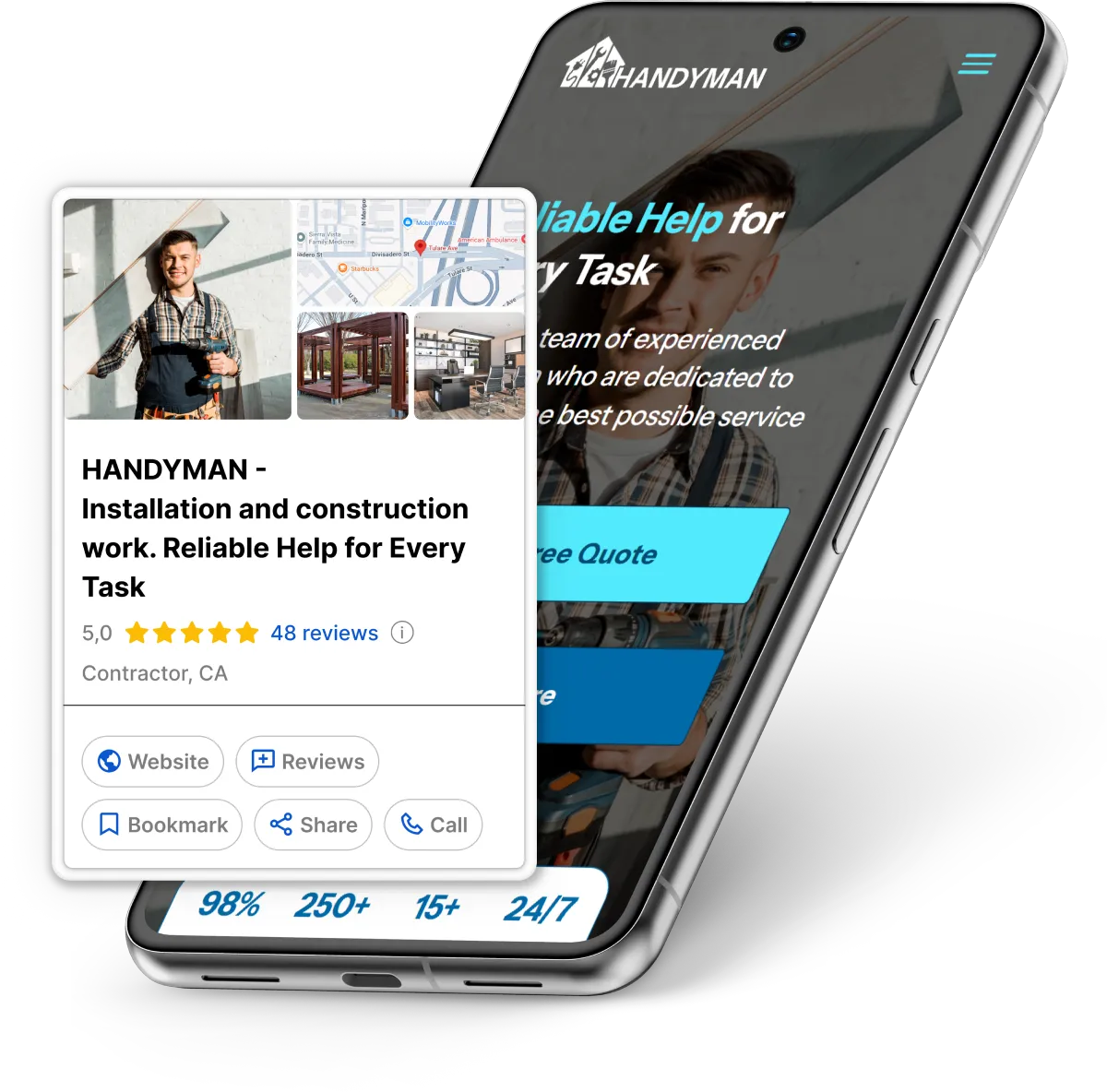
For a local trade, the Google Business Profile is usually worth more than the website — and it is free, which makes it the most obviously underused thing in the industry.
Most local searches for a contractor never reach ordinary blue-link results. They are decided in the map pack: the three businesses shown with pins, ratings and a call button. That block is drawn from Business Profiles. If you are not in it, most of the search never sees you.
The good news is that competing there is not about budget. It is about filling in a handful of fields properly, and most of your competitors have not.
Set it up as a service-area business
This is the first decision and the one people get wrong.
If customers come to a shop or a yard, you have a physical location and you show your address. If you drive to customers — which is most trades — you are a service-area business: you verify using an address, then hide it, and list the towns and areas you actually work in instead.
Two things matter here. Do not invent an address in a town you would like to work in; it risks the whole listing. And do not list forty towns because you would drive there in an emergency. List where you genuinely work, because relevance across a smaller area beats a thin claim on a huge one.
Get the primary category exactly right
Your primary category does more than any other single field to decide which searches you appear for. Not approximately right — exactly right.
If you are a plumber, “Plumber” is the primary, not “Contractor”. If you fit and service boilers, “Heating contractor” may be a better primary than “Plumber” — look at what people actually search for when they want the work you want.
Then add secondary categories only where they are genuinely true. A handful of accurate ones beats a long list, and irrelevant categories dilute what the profile is about.
Fill in every field, including the dull ones
The completeness of the profile is itself a signal, and each field is a chance to match a search:
- Business name exactly as it is in real life. Stuffing keywords into it — “Dave’s Plumbing Leeds Emergency 24/7” — is against the rules and gets listings suspended.
- Hours, honestly, including whether you take emergency calls outside them.
- Services, listed individually. Water heater repair, drain clearing, repiping — not one entry saying “plumbing”.
- Description, written for a human, saying what you do and where.
- Attributes where relevant.
- The website link, which is what turns a listing into an enquiry for anything bigger than an emergency.
Photos are not decoration
Profiles with real, current photos get taken seriously. The ones that work are unglamorous:
- Finished jobs, photographed on your phone in decent light
- Your van, with the signage visible — it makes you concrete and local
- You and your crew, because people hiring a stranger like to see a face
- Before-and-afters, which sell the work better than any description
Add a few every month rather than thirty once. A profile whose last photo is three years old reads as a business that has stopped.
Reviews are the whole ball game
Between two similar contractors, reviews decide it. There is no clever way around this, only a habit:
Ask at the moment the job finishes and the customer is standing there pleased with it. Not by email a fortnight later. Send the direct review link the same day, while you are still fresh in their mind.
Then answer every review. Thank the good ones briefly. Answer the bad one calmly, factually and without arguing — that reply is not for the person who wrote it, it is for the next fifty people who read it. A single measured response to a complaint does more good than five more five-star ratings.
A steady trickle beats a sudden burst, which looks exactly like what it usually is.
What is worth less time than people think
Posts. They keep the listing looking active, which matters to human readers. They are maintenance, not a growth channel. Batch them monthly and move on.
Chasing the exact ranking. What you see is personalised by your own location and history. Judge it by calls and by the profile’s own view and action figures, not by searching your own trade from your kitchen.
Where the website comes in
The profile gets you seen. The website is what the person taps through to, and what convinces them — especially for planned, higher-value work where nobody hires from a listing alone.
They also reinforce each other: a profile pointing at a real, relevant site is a stronger listing, and the site gives you somewhere to answer the questions the profile has no room for. That is the full argument here, and the trade-specific detail is on the by-trade pages.
We set the profile up as part of every plan — what that costs is on one page, and the usual questions are answered plainly. If you would rather just see what your own site would look like first, the free preview costs nothing.
FAQs About Google Business Profiles for Contractors
Profile Set Up, Site Built, Both Kept Current
Request My Free Preview